The Chop Salutes a True British Hero

article
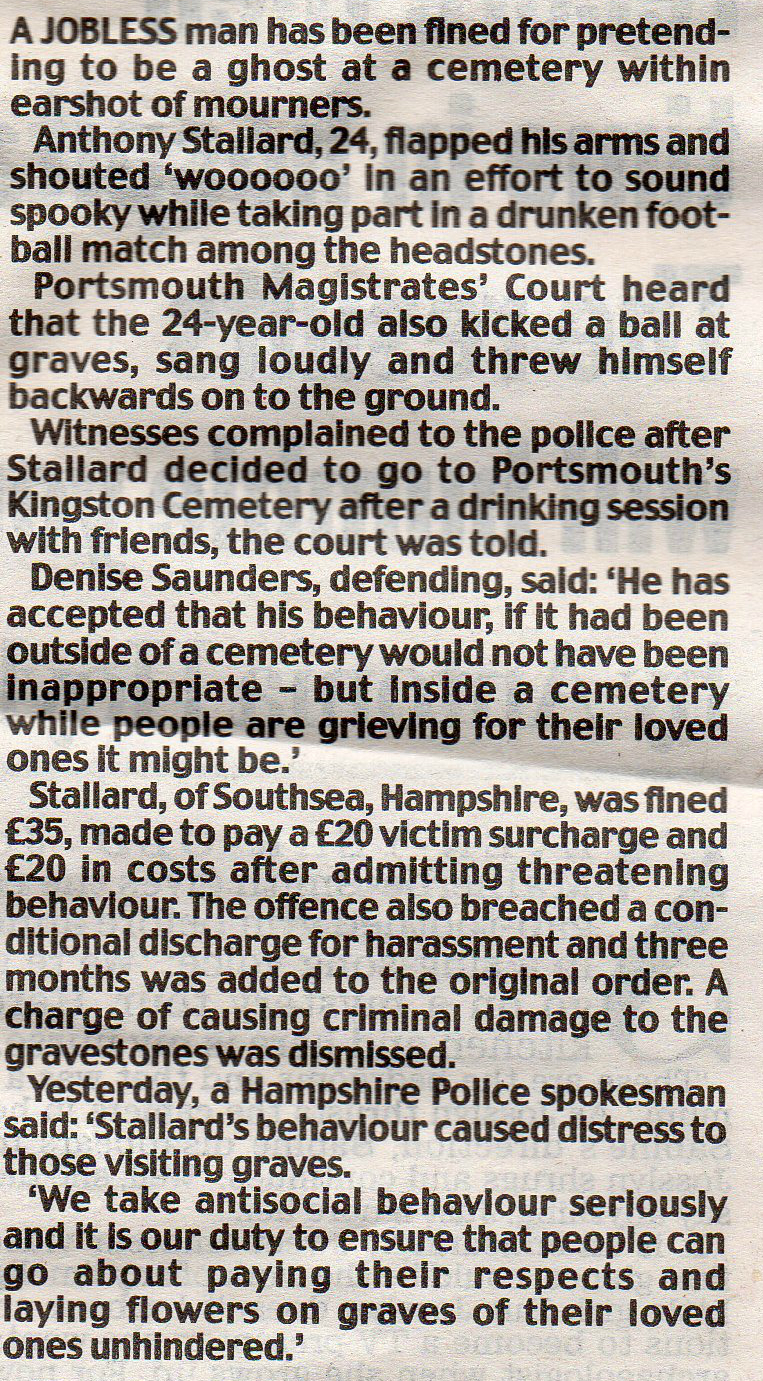
There’s been much made lately of the dysfunctional state of American Justice. But as imperfect as our system is, having just come back from three months abroad we’re practically overjoyed to be back in Baltimore, Maryland USA. Take for example this cruel abortion of jurisprudence we found in the pages of London’s Daily Mail this week. As you can see for yourself, whilst the sons of Tories are hunting foxes and being given peerages, such a fine young man as our Stallard here are being aggrieved and fined simply for enjoying a right that we Yanks hold sacred: the very Pursuit of Happiness.

First of all we’d like to take issue with the writer’s leading by describing Stollard as ‘A JOBLESS man…’ right off the bat. What business is that of yours, eh? How dare he sit in his newspaper office with his AP wires and his fancy desk and his cups of tea and pass judgement on a working class lad who happens to be down on his circumstances at the moment! Times are hard for those of us with mouths empty of silver spoons.

In our view, Anthony Stallard should be saluted for having the courage and good sense not to waste his days knocking at doors hat-in-hand begging for some menial job or other but instead showing that there are still Britons with the fortitude to do as they please with the dignity befitting a man.

Now, there are some among you who may judge Stallard for drinking during the day. Hypocrites! The lot of you! If he’d been in some magazine’s vapid 30-under-30 list you’d think nothing of him having a pint at lunch or ‘networking’ at happy hour. But who can judge Stallard who’s not walked a mile in his shoes? Sometimes a few pints and a little moral support for one’s mates is absolutely necessary when the chips are down. Hell, we wouldn’t be surprised if Stallard had no choice but to seek refuge in his local before sundown; he’s probably got a shrill harpie of a mum nagging him all the day at home.

And besides: it’s not as if he were sitting around the pub all day. In our view Stallard is to be admired not only for keeping fit on the football pitch but for having the spirit and good cheer to sing while he was at it.

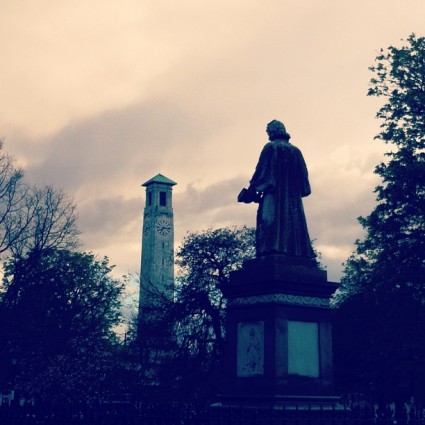
In fact, as near as we can tell, the only fault we can find with Anthony Stallard here his that he admitted anything at all to the court. We would encourage him, the next time he finds himself at the mercy of Her Majesty’s courts to keep his upper lip as stiff as Sidney Carton’s. He should have made the court prove that there was no ghost. The Chop has seen British cemeteries, and as you can see from this photo we took they’re pretty fucking creepy. We contend that there very likely was a ghost involved in this case, and submit that it’s also possible that if Stallard were seen waving his arms and saying ‘woooo’ it’s possible that the ghost had in fact possessed him. Indeed, Stallard has been victimized twice here: once by a terrifying brush with the supernatural and again by the Crown’s courts.

A Reference Guide to Baltimore Rowhouse Types

After writing up a post on the history of Baltimore City recently we were inspired to go out and pick up a copy of The Baltimore Rowhouse Mary Ellen Hayward and Charles Belfoure. We really can’t recommend it highly enough. The authors begin all the way back in the 1700’s when the city consisted mostly of large land grant estates and does a great job of explaining how those estates were eventually subdivided and developed, from the very first wooden shacks to the golden age of builders like Keelty and Gallagher, who built most of the iconic Baltimore rows to modern infill construction and renovation.

The book also did an outstanding job of explaining the different styles of rowhouses found in the city, and illustrating what got built where- and when and why. At times it goes deeper into details on architecture and building technique than most people would ever need to know, but remains an interesting read nonetheless. But what if you want to know the various rowhouse types without spending $27 and reading through 200 pages? Never fear. The Chop is here with an illustrated book report.

This post is meant to show the most common types of rowhouses found in Baltimore, and to match their names to their pictures. We’ll also do a tiny bit of explaining along the way. The Chop is, of course, not an architect or anything, so if we’ve got anything wrong here or if there’s something that should be added we’d encourage those more in the know than we are to send us an email.
053

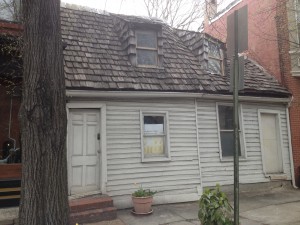
Wood Frame Houses. Are these the oldest houses in Baltimore City? Yep. They’re on S. Wolfe St in Fell’s Point, which was one of the earliest developed areas of the city. The fact that they’re made of wood indicates they were built before 1799 when wood frame construction was made illegal in the city. This is likely what most of the original housing in Baltimore town looked like.
048

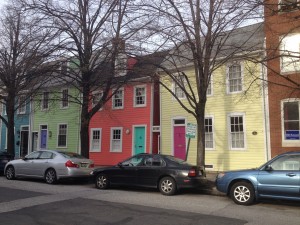
Here are some wood frame houses nearby on Ann St, which are also likely among the oldest in the city, but probably a few years more recent than those above, and clearly better maintained. These begin to resemble what we think of as rowhouses.
Untitled

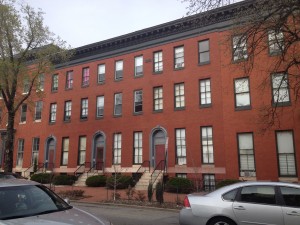
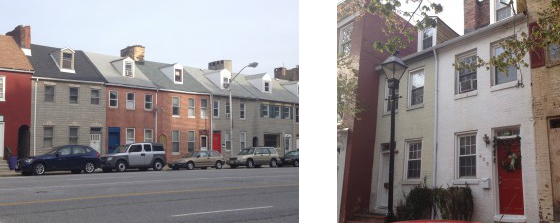
Federal Style Houses From 1800 Federal style houses begin to appear in the city’s oldest neighborhoods. In general large, fine houses were built on main streets, smaller versions erected on side streets, and tiny versions on alley streets. Before cars and buses presented the problem of noise living on a large, wide street was very desirable and this construction pattern was in wide use all over the city from 1800 until the early 1900’s. Above is a large Federal house on Central Avenue alongside a small alley version in Seton Hill.
041

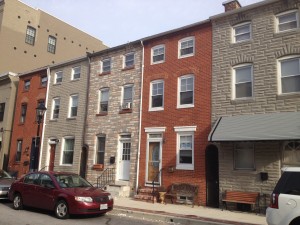
Two Story and Attic Also very common around the oldest neighborhoods of the city near the harbor is the Two Story and Attic rowhouse. These were mostly occupied by blue collar workers’ families and don’t tend to vary much wherever they appear.
049

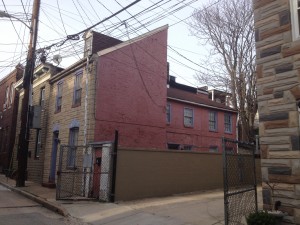
Half-House Appearing mostly in alleys or small side streets the half house is only one room wide and one room deep with a lean-to at the back. These may or may not have been meant to be added to later but many were not.
050

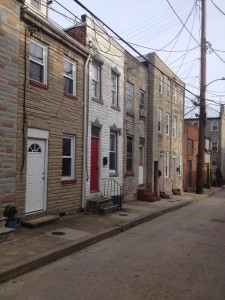
Alley Houses An alley house is only two rooms deep, though most have since had small kitchens and bathrooms added (Before 1907 the city had no sewers. If a house is older than this it would have had a separate shithouse in the back yard and the current bathroom is retrofitted.) In Britain these are called a “two up-two down” but here we call them alley houses or crackerboxes. Having lived in one of these as a rental we can tell you it’s pretty miserable.
036

034

030

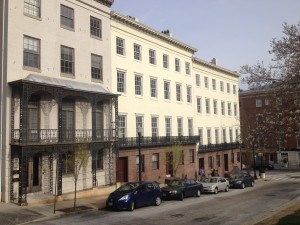
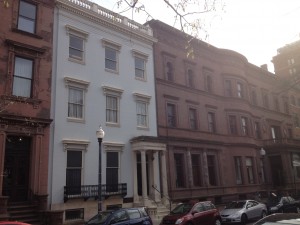
Greek Revival Favored by the rich in the mid 1800’s the Greek Revival style was in heavy use around Mount Vernon, which was at the time home of the city’s monied elite. What was built there by leading architects influenced the rest of the city, especially around parks and squares. Early developers invented a scheme whereby they could donate a plot of land to the city for a park, then build around it using the park to enhance property values. This is how places like Franklin Square, Union Square, Johnston Square, etc came to exist.
Untitled

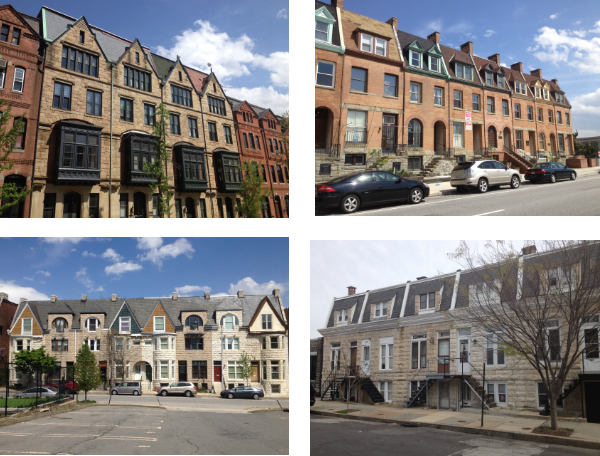
Picturesque Houses Picturesque styles like the Queen Anne and others represent the second wave of Big Money houses which began to appear north of the Washington Monument in the late 1800’s. Some of these were truly ‘town houses’ serving as pied-a-terres for incredibly wealthy owners who owned country estates outside the city as well. They generally appear around Mount Vernon, Station North, Barclay, Bolton Hill and Reservoir Hill, all of which took their turn as the city’s most fashionable neighborhood for wealthy buyers.

They’re not what we think of today as just another rowhouse, and while they are limited to a few neighborhoods their influence on the rest of the city’s housing design was important. These houses were influenced by the latest styles in London and Europe, and builders of working class houses wasted no time scaling down and copying elements for use on much smaller houses. Things like stone porches and false attic windows which appeared on some Daylight rows owe their inspiration to these designs, and in places like Highlandtown even ordinary Italianate houses sometimes appeared with tiny front balconies or spires. Also shown here in the lower right corner is a row of houses in Remington which are an extreme example of builders shrinking and copying the houses of the rich for a working class market.
016

Renaissance RevivalHouses like this one on West 29th St aren’t notable for their proliferation, but were very influential to the bulk of rowhouse design.
Untitled

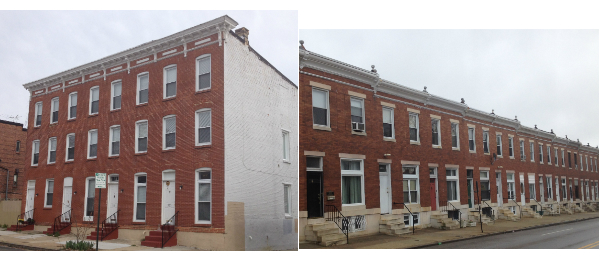
Italianate Houses Shown here in the two and three story version this is what we think of as the Classic Baltimore Rowhouse, especially the two story version with marble steps and other marble finishes cut from Beaver Dam Quarry in Baltimore County. These were built from the late 1800’s until the time when the Automobile took over after WWI, in generally the same pattern described above: three story versions on main streets, two story ones on side streets and tiny ones in the alleys. In 1908 a law was passed mandating a forty foot width for streets, so parts of the city developed after then used only a main street/side street approach.
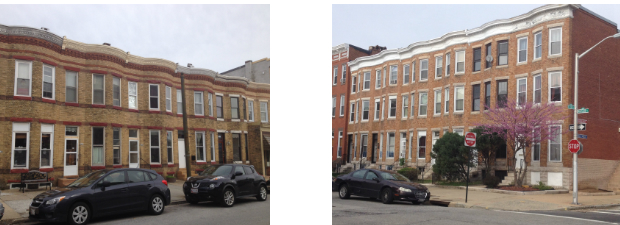
Untitled

Swell Fronts Also shown in the two and three story version, some builders of Italianate houses chose to swell the fronts to break up monotony and give buyers a little more room.
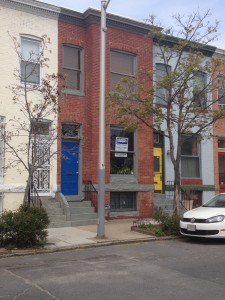
086

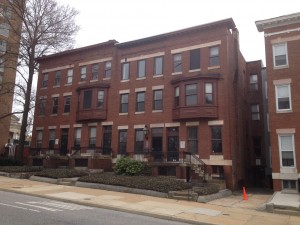
Square Fronts The book didn’t mention this particular type of house but we’re just going to go ahead and refer to it as a square front. It’s a squared off version of the swell front and isn’t very popular in Baltimore although it can be found scattered here and there. You’ll find many more of these in DC.
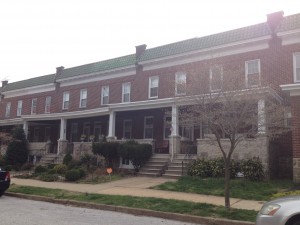
021

Daylight Rowhouse Pictured above is the one of the most common versions of one of the most common house types in town. This particular row on Tudor Arms Avenue is extraordinarily well maintained and probably looks much like it did when it was built around 1920. The Daylight rowhouse usually has a three bay wide floor plan that allows light into all six rooms. While finishing touches vary, they’ve all got roughly the same basic design and are much more comfortable to live in than two story Italianate houses.
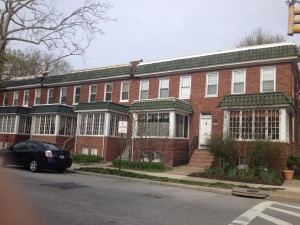
027

Daylight Sunporch One of the variations on the Daylight house is the Sunporch version, which is worth noting as its own subtype. All of the green tile is actually painted, formed sheet metal.
Untitled

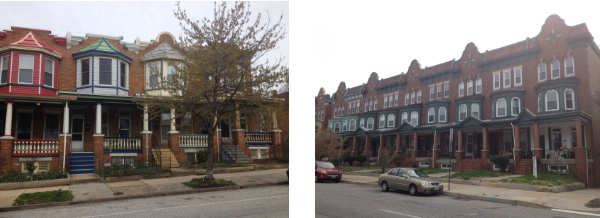
Porchfront Houses Again shown in two and three story versions and sometimes called sunlight houses, Porchfront houses were built at the same time as the Daylight rows. These two house types were the first to have porches as well as little front yards and maybe a garden and garage space in the back. They were built to compete directly with single family homes going up in the suburbs. After they became popular builders began slapping porches on most house types, although if you call a house a ‘porchfront’ most people are going to assume you mean the type pictured here with a bay window on the second floor and a covered porch as a feature. When painted brightly like the ones in Abell pictured above these are sometimes referred to as Painted Ladies.
Untitled

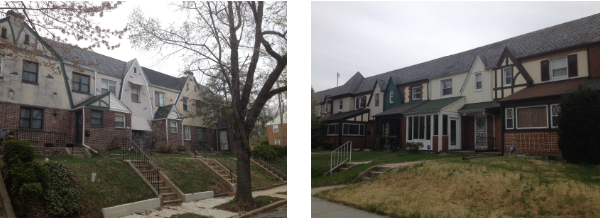
English Rows Inspired by English country cottages, English rows are kind of the love it or hate it country cousin of Baltimore rowhouses. You can find them near the city’s borders in places like Dundalk, Ednor Gardens (pictured) and even up around Pimlico.
003

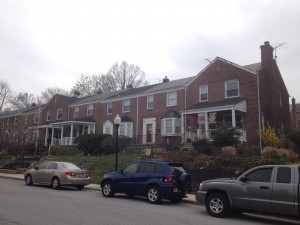
Neocolonial Rowhouses Some of the last ‘old school’ rowhouses built in the city, Neocolonials can also be found around and outside the city’s borders and have a distinct suburban feel. They’ve got decent yards on both sides and larger, coveted end-of-group units. Many of these were built after WWII when vets were coming home to good jobs and access to VA loans.
Horse Betting Tips for Amateurs

Yesterday the Sun came out with a very basic Preakness explainer. It’s a handy thing to read because most of us here in Baltimore pay attention to horse racing for about fifteen minutes out of the entire year before we go back to forgetting that it exists entirely. If you’re one of those folks who likes the national spotlight and the prestige of a large event but doesn’t know the first thing about horses, this post is for you.

The Chop is part of a very small minority among Baltimoreans; people who actually go to the races on days other than the third Saturday in May. After several years and even a turn working on the backstretch we’ve learned how to be able to bet all day and not lose our shirt in the process. Now that it’s Triple Crown season if you’re entertaining some interest in horse racing but don’t really know much about wagering: follow the advice below. We’ve found that other betting advice articles you will come across online are severely lacking because all they really do is explain the different types of bets and are reluctant to treat their readers like idiots. We’re not going to waste time rehashing what’s already explained in the program. But the track is counting on a lot of dumb money flowing into the pools, so the ignorance of casual bettors is just fine with them.

1. Learn how to read the program. There’s a page right in front of the program that tells you how to read it, complete with a diagram. You should study this carefully. It takes a lot of practice to really make sense of a racing program, but if this is your first time ever seeing one a few things to look out for are the recent Beyer Speed figure numbers, the horse’s class rating, the amount of money the horse has won previously and the level of races in which it’s been running.

2. Decide which horses definitely WON’T win. You should not be betting long shots. Let us say that again: Do not bet long shots. If a horse’s odds are more than 20:1 he’s almost certainly not going to win, and if he does you’re not smart enough to have predicted it. Anything between 10:1 and 20:1 would be a very lucky guess, and if you’re new to the sport you’re not going to be able to handicap nearly well enough to nail a 15:1 horse even hitting the board. The odds on the average winner are about 5:2. With that in mind you should throw out any horse over 10:1 and choose among the remaining runners.

3. Bet the horse, not the price. So let’s say you’re looking at three horses in a race and trying to decide which one to bet. The one you like on paper had a 4-1 morning line but is posting up at 6:5 ten minutes before the race. You were excited about getting 4:1 on a horse you think is going to come through but 6:5 seems like a lot of risk for very little reward and you think you might go for that other runner who’s now 3:1. Don’t do that! Whatever the prices on the board are you have to bet on the horse you think is going to win. If the risk/reward isn’t good enough you should probably look at changing your bet type or amount.

4. Don’t discount Place and Show bets. Personally we like to bet horses across the board if they’re going off better than 2:1. If you’re picking a horse to win you’ve got to be really far off your guess to see it run fourth or worse. Sure, a $2 show bet pays virtually nothing, but you’re an amateur and just learning the game. A straight show bet makes the race interesting and is pretty tough to lose if you’re betting a good horse. Go as high as $10 on one if the horse consistently runs in the money.

5. Stay the hell away from exotic bets. You’re a beginner who just learned how to read a form, right? Why the hell would you think you’re clever enough to pick a trifecta? You’re not. And if you start trying to hedge by boxing horses you’re going to end up wagering a lot more than you even realize. Pick one horse per race. Preferably the winning one.

6. That being said, learn what a Key is. If the horse you want to bet is going off at 2:5 a good bet is probably an exacta key. That horse “with/” two or three others you think might run second. But only 2-3, not every horse in the field.

7. Consider the daily doubles and pick threes. If you’re torn between two horses in race five take one to win and the other in the first half of a daily double for $1. If the one you picked in the double comes in, bet nothing else on the sixth race and see if your double comes up.

8. Listen to the track handicappers. Race winners are almost always one of the four horses listed in the ‘Program Selections.’ Usually the track handicapper is going to pick one of these horses, probably the first or second. They’ll tell you why too. You’re free to disagree, of course, but the handicapper knows a hell of a lot more about horses than you do and you’re not smart enough to completely ignore free advice.

9. Look at the actual horse before you bet the race whether it’s in the paddock or parading on the track. If you’re just learning how to bet you’re probably not a very good judge of horseflesh but at the very least make sure the horse looks calm and relaxed before the race. Skittishness is usually not a good sign.

10. Look at the groom who’s escorting the horse to and around the paddock. The groom is the person who the trainer has hired to spend the most time around a horse every day of its life. Does the groom look like a professional horseman who showed up well dressed counting on being in a winners circle photo? Or does he look like a goddamned itinerant junkie who sleeps above the barns and cuts out of morning workouts for a trip to the methadone clinic? Hiring and retaining a professional groom is a good indicator that the trainer is running a class operation from top to bottom and is running to win, not just running to run.

How to Know if You’re an Oriole Park Basic Bitch

You Guys! There’s a slightly-past-peak way to insult people on the Internet and Vox is ON IT! Ezra Klein’s very Basic new website is here to blogsplain Basicity in a way that even your grandma will understand when she sees it on your Facebook wall.

So what better time than now to highlight the one place in the whole city of Baltimore where the Basic Bitch (and her male counterpart the Basic Bro) run wild and free by the thousands. We don’t mean Power Plant Live. We’re not referring to Federal Hill. We’re talking, of course, about Oriole Park. As the ball club’s gotten better over the last few years the profusion of Basic Bitches at Oriole Park is at an all-time high. Not that we’re complaining, mind you. Who wants to watch a game with nothing but old dudes and kids in the stands?

But now that Basicity is top-of-mind on the World Wide Web it might be a good time to examine yourself and your behavior at the stadium and see if you are, in fact, an Oriole Park Basic Bitch. Below are ten markers of Basic behavior at the Yard. If you catch yourself doing more than one or two of these at a game you are definitely a Basic Bitch.

1… You go to Pickles’ Pub, Sliders, etc before the game. A friend who works at one of the bars in that strip said recently that 81 times a year it’s full of people who think they’re doing “Preakness Lite.” That should tell you everything you need to know. You can see that it’s a throbbing mess of humanity and cheap beer from outside the gates and yet you still want to cram inside? You Basic.

2… You take selfies during the game. Usually in the aisle during play and usually while we’re trying to note the finer points of the game. We get that you only attend like one or two games a year and it’s a special occasion for you but knock that shit off and act like you’ve seen an MLB game before. You Basic.

3… You’re wearing VS Pink branded merchandise. Again, not complaining because the Chop likes boobies and midriffs as much as the next sports fan and at least it’s not that Kelly green faux-Irish garbage but shelling out $55 for a T shirt in the mall means you definitely basic. Try wearing street clothes in orange or black or maybe just a cap instead.

4… You’re in on a Student Night ticket. Damn near every college student everywhere is Basic. College is that magical time when you get treated like an adult but you actually aren’t one. All the shit that you think is cool and important really isn’t, it’s just Basic, like you.

5… You yell and cheer and otherwise display Team Spirit. You know how all those people always say that baseball is boring? Well they kind of have a point. We watch about 300 baseball games a year so we ought to know: it’s rare that you need to be actually excited about something. Basic Bitches do the Wave. We’ve never met a real fan who actually likes the wave. You Basic.

6… You talk about the Ravens or in any other way compare baseball to football. If you just want to play dress up and chant 7 Nation Army and suck down Miller Lite you can do it at the Greene Turtle. You Basic.

7… You eat ball park food for dinner. A hot dog might be okay if you came straight from work but if your whole party is eating chicken tenders and those awful crab dip waffle fries as dinner what the hell? There’s this popular idea that ball park food is part of the whole ‘experience’ and it just ain’t so. The food at Oriole Park is mostly bad. If you want the ‘experience’ buy a sack of peanuts on the street outside the stadium. You Basic.

8… You showed up late. it’s not a strict rule that you need to be in your seat by the time they sing the Anthem, but if you’re showing up in the third inning you are almost certainly Basic. What’s that? You had to drive around looking for the cheapest and closest parking garage? Our point exactly. You basic.

9… You’re on your phone after the second inning. Put the damn thing away for once in your life. There’s no fear of missing out because Oriole Park at twilight in the Summer is already the best place on Earth and you’re there. Plus there’s no cell service in that damn stadium. You Basic.

10… You think it’s okay to litter, piss in public, yell and scream, etc as soon as you’re two blocks from the park. If you came from Timonium or Severna Park or Harford County or any place like that then don’t do shit in our city that you wouldn’t do in your own fucking neighborhood. Admittedly Basic Bros are the main offenders here but Jesus, the disrespect that some people show toward our city is infuriating, especially when they then return to the suburbs and look down their nose at the city for being dirty and dangerous. You Basic.

Pee Wee’s Big Adventure @ Landmark Harbor East Tonight

It’s that time of year (okay, it’s all year) when all of your Facebook friends are all like “Hey guys, guys, you guys! I’m doing ______ for the ______ this year here’s my donation page pony up it won’t kill you! They’re all very well intentioned but maybe they don’t realize that everyone is running for awareness and blogging for dollars and Kickstarting Indiegogos and selling Girl Scout Cookies. And it all adds up to a fatigue with the Charity Industrial Complex.

But we wanted to take a second to highlight a couple of Ride For the Feast fundraisers going on this week that are going to be really fun events and offer not only a way to chip in for a good cause but a lot of bang for your entertainment buck.

The first is a screening of Pee Wee’s Big Adventure in Harbor East tonight at 6:30. $20 gets you a couple of cocktails at the pre-show reception and covers your ticket, and Pee Wee’s Big Adventure is not only a hilarious classic comedy that’s fun for all ages but is also a bike-centric movie. Here is the Facebook Event Page.

Also tomorrow Woodberry’s Union Brewing will be holding a Brew for the Feast party to benefit one of the riding teams. Tickets to that are also $20 (not sure what all’s included) and the 4 hour event features some top notch food, tasty beers and gorgeous Spring weather. If you’ve never been to an event at Union you should go to one ASAP, and if you have been to one you know it’s impossible not to have a good time there. Here’s the link for tickets.